Tennoji Zoo Visiting Tips: Tickets, Access and a Family Half-Day Plan
Tennoji Zoo is an easy half-day stop for families: visit animals in the morning, have lunch in Shinsekai, then continue to Tennoji or Abeno. Admission is ¥500 for adults and free for preschoolers, while weekday mornings are generally easier to walk around. You do not need to spend the whole day inside.
# Tennoji Zoo Visiting Tips for Families: How to Plan Your Day
Walk from Tennoji Station in the morning and the open space around Tenshiba gradually blends into the busier streets towards Shinsekai. Tennoji Zoo sits between those two sides of the city. It is well placed for a zoo morning, lunch in Shinsekai, and an afternoon in Tennoji or Abeno.
As hosts in the Teradacho and Tsuruhashi area, we see many families choose this route. With adult admission at ¥500 and free entry for preschool children, it is fairly straightforward to plan for families with children of different ages or for three-generation trips. On a weekday morning, the grounds are usually easier to explore at your own pace.
Who is Tennoji Zoo suited to?
Tennoji Zoo suits families who want a little of Osaka’s character without turning the day into a long, tiring walk for children. You can pair the zoo with Shinsekai on one side and Abeno on the other, which is what makes the location genuinely practical.
It is tempting to add Dotonbori to every Osaka itinerary. But from a local host’s point of view, families often have a smoother day if they leave time for the Tennoji side instead. See the animals, take a break outdoors, and eat a proper meal. It is an ordinary rhythm, but one that is less likely to fall apart halfway through the day.
Large animals, smaller discoveries, and reasons to keep walking
The Africa Savanna Zone is likely to catch your attention first, with lions and giraffes. The open views make it easier for children to spot what comes next and start walking on their own, while adults with strollers can keep the route manageable. In the morning, you may still have enough patience to ask, “Ready for the next one?”
The Asian Tropical Rainforest Zone has a different feel, with red pandas and orangutans to look for. After the larger animals, it brings your attention a little closer in.
For younger children, check the official same-day information for the petting area’s operating hours and age requirements. It is an area where visitors may meet goats and sheep, but programmes can change according to events or the animals’ condition. At a zoo, it is often more satisfying not to rush through everything, but to let children spend longer where they choose to stop. Adults tend to worry about the next plan—understandably—but time spent watching a bird can become part of the day’s memory too.
Admission and opening hours: know these first
Regular admission is ¥500 for adults (high school age and above), ¥200 for elementary and junior high school students, and free for preschool children. Annual passes are ¥2,000 for adults and ¥800 for elementary and junior high school students. For a half-day with children in Osaka, these prices make the budget relatively easy to estimate.
The zoo is normally open from 9:30am to 5:00pm, with last admission at 4:00pm. It is closed every Monday; when Monday is a public holiday, it closes on the following weekday instead. Seasonal events and temporary arrangements can affect this, so check the official opening calendar before leaving.
A Night Zoo is sometimes held in summer, offering a chance to see nocturnal animals moving in a different atmosphere. Dates and admission arrangements need to be checked each year. Do not assume it will be running simply because it is summer—check the actual date.
- Head to the Savanna Zone soon after entering, while everyone still has the focus for the larger animals.
- If you plan lunch in Shinsekai, keep the route towards the north entrance in mind.
- With elementary-school children, show them the map and let them choose one animal they want to see next.
- For three-generation groups, prioritise rest and toilet breaks over completing a full circuit of the zoo.
Which station is easiest for Tennoji Zoo?
If you are travelling light and entering after exploring Shinsekai, Dobutsuen-mae Station is convenient. If you are using JR or want to include Abeno, Tennoji Station is usually easier. Choose based not only on where you enter, but on where you want to go after the zoo; it can save you retracing your steps when everyone is tired.
Dobutsuen-mae Station: for a Shinsekai-focused route
From Dobutsuen-mae Station on the Osaka Metro Midosuji Line or Sakaisuji Line, it is about a five-minute walk from Exit 1. This works well if you want to walk through Shinsekai first, past Tsutenkaku and Janjan Yokocho, then approach the zoo’s north side.
Towards lunchtime, people gather outside kushikatsu restaurants, and the smell of frying oil mixes with calls from restaurant staff. It can feel like a lot on your first visit, but it is also one of those scenes that makes you think, “Yes, this is Osaka.”
That said, do not choose solely because the walk is about five minutes. With a stroller, large suitcases, or summer heat, stairs, exit locations, and where you plan to eat all matter. Some families will find the Tennoji Station side calmer. Honestly, who is walking with you matters more than the number of minutes on a map.
Tennoji Station: useful for JR and Abeno sightseeing
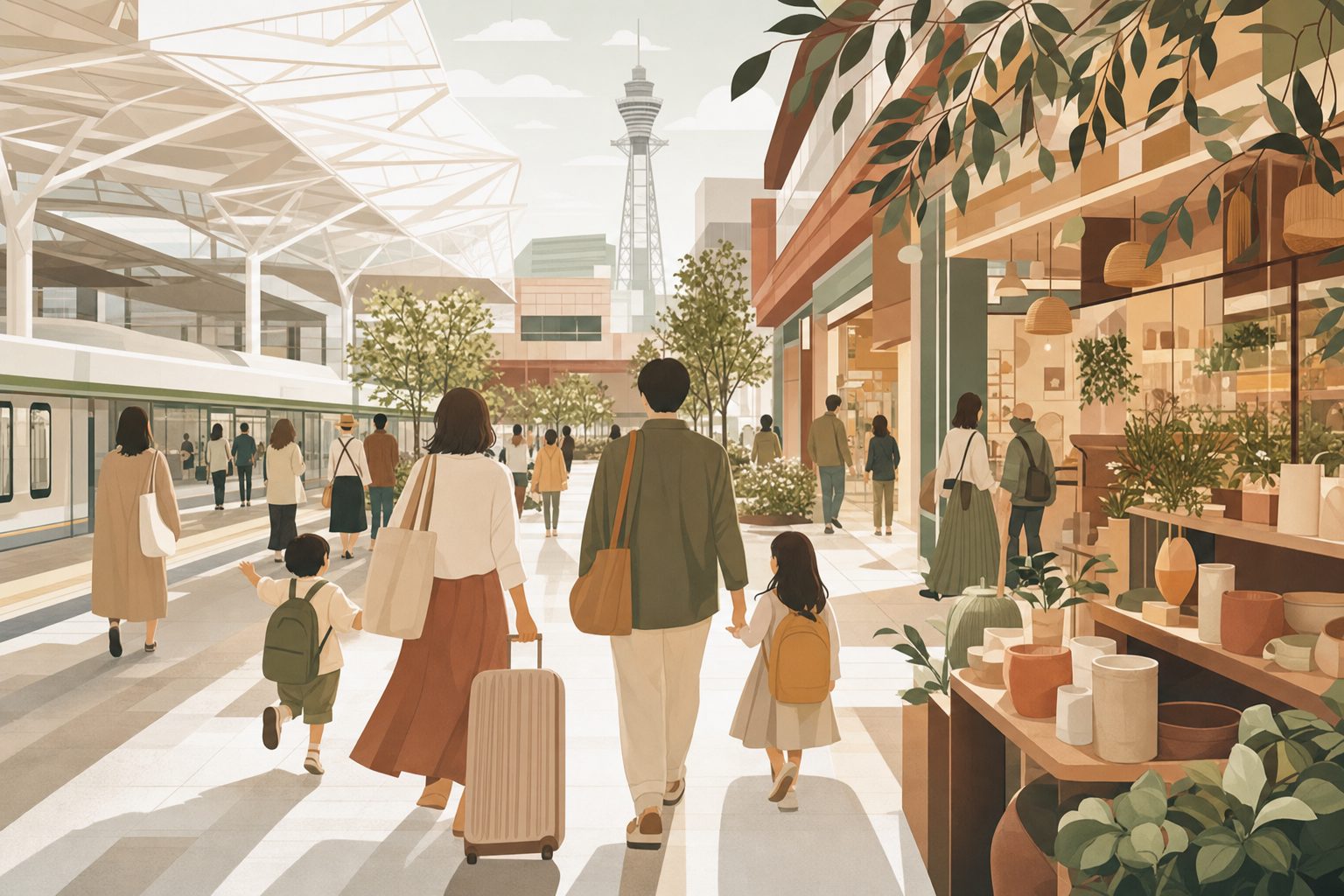
From the central ticket gates at Tennoji Station—served by JR, the Osaka Metro Midosuji Line, and the Tanimachi Line—the zoo is about a 10-minute walk. Allow around 10 minutes from Tennoji-ekimae Station on the Hankai Tramway Uemachi Line as well.
This is the more straightforward route if you want to include Abeno Harukas, the shopping facilities around the station, or Tenshiba on the same day. It is also easier to organise errands in and around the station, which can be helpful if rain is a concern.
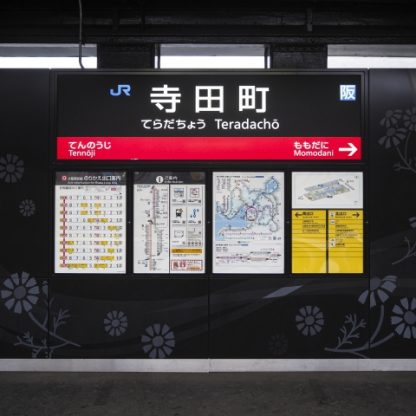
From Teradacho, Tennoji is one stop on the JR Osaka Loop Line, taking about two minutes. From Tsuruhashi, it is three stops and around five minutes. From Tennoji Station, still allow about 10 minutes on foot to the zoo. The train ride looks very short on paper, but on a family trip, the walk from ticket gate to entrance can take longer than expected. Plan from the time you put your shoes on at your accommodation, rather than just the train timetable.
POINT
If you arrive from Tennoji Station, consider making the zoo a one-way walk and leaving towards Shinsekai. You avoid returning along the same route. If you plan dinner or shopping around Tennoji Station, however, it is easier to head back south rather than exit towards the north.
If you want to continue to Namba or Kuromon Market
From Tennoji Station, Namba Station is about five minutes on the Osaka Metro Midosuji Line. Dotonbori is then around a five-minute walk from Namba Station, while Kuromon Market is roughly a 10-minute walk from Namba Station.
If you leave the zoo in the morning, it is possible to visit Minami in the afternoon. Osaka really is close together once you get on the train.
Still, for families with young children, we would not recommend fitting Tennoji Zoo, Shinsekai, Kuromon Market, and Dotonbori into one day. Guides often add Dotonbori automatically, but Tennoji and Abeno are usually easier to enjoy at a family pace. Osaka’s sights are compact, but overfilling the day can leave you remembering only the transfers. Dotonbori will still be there tomorrow.
Tennoji Zoo visiting tips for avoiding crowds and planning your route
For a calmer visit, enter between about 9:30am and 11:30am on a weekday and make the zoo the main purpose of your morning. Visitor numbers rise on weekends, public holidays, and school holiday periods, so allow extra time for admission, meals, and animal-contact programmes. If lunch in Shinsekai is fixed in your plan, decide roughly when you want to leave the zoo so you are not rushing at the end.
Why a morning visit works well
Entering at opening time makes it easier to walk outdoor areas before the heat builds, and it gives you more breathing room when looking for lunch. Shinsekai restaurants become busier as noon approaches, so simply visiting the zoo in the morning and aiming for lunch around 12:00pm can change the feel of the day.
Many travellers initially think, “We can go after lunch and stay until evening.” But last admission is at 4:00pm and the zoo closes at 5:00pm. Arriving in the afternoon can mean watching the clock while your child is standing in front of the animal they most wanted to see. A morning with some spare time tends to feel more like a holiday, even if getting up is a little harder.
A practical half-day order
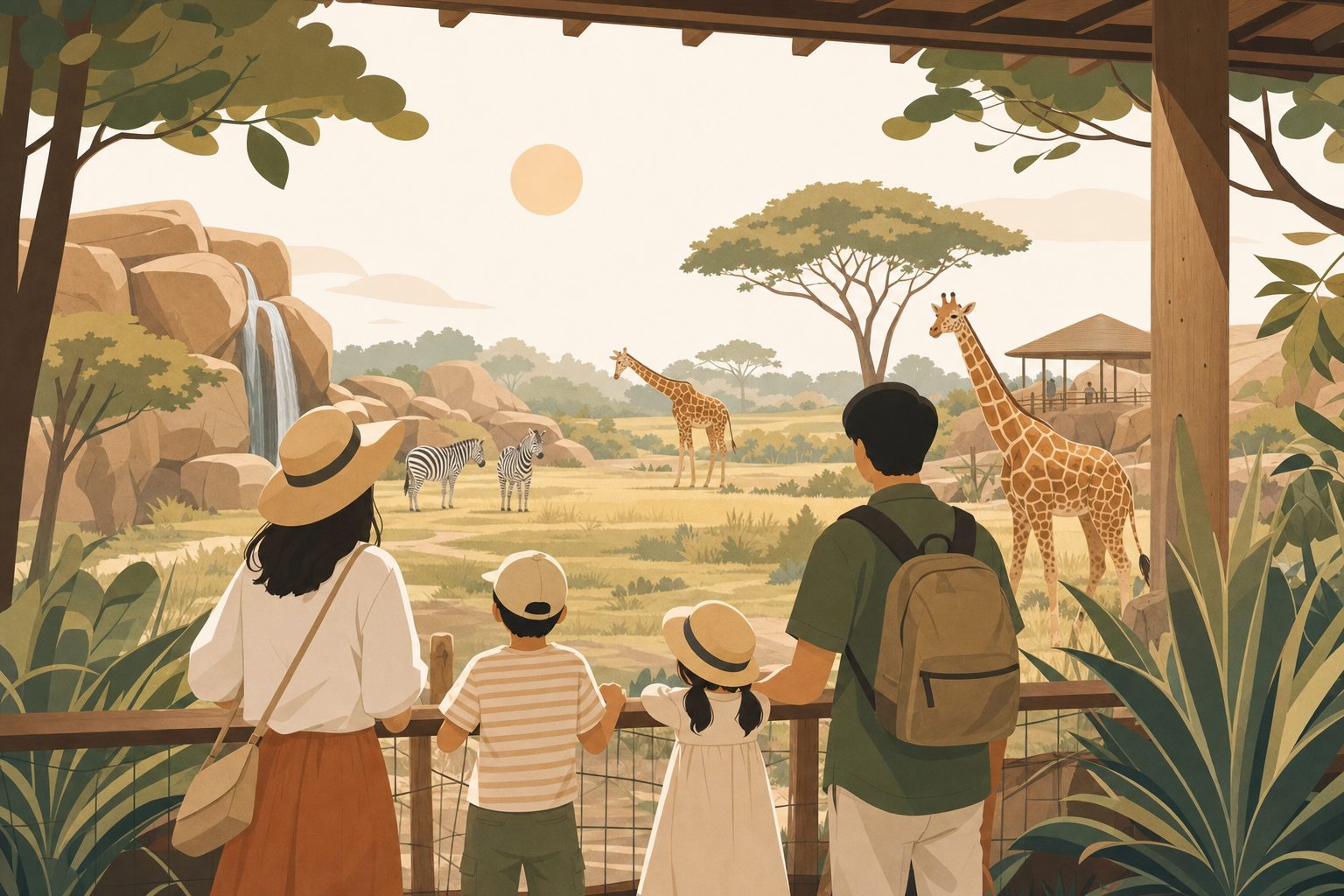
The order will vary with crowd levels, your children’s breaks, and where events are held that day. For a first visit, though, it is easy to start with the outdoor large animals, continue to the tropical rainforest area, and then check the day’s petting-area information. This is not a timetable to complete perfectly; it is an order that is easier to recover if you need to stop halfway.
9:30–10:00am: Enter the zoo
Check the map and same-day event information, then head first to the Africa Savanna Zone.
10:45–11:30am: Tropical Rainforest
See the red pandas and orangutans, and take one proper break for children.
From 12:00pm: Head north or south
Go north for lunch in Shinsekai, or south towards Abeno and the Tenshiba area.
What to bring and how to think about breaks
In summer, bring a hat, drinks, and a towel. In winter, a wind-resistant outer layer makes the walk more comfortable. Adults may want to move on to the next animal, while children may stop for a puddle or a bird. Leaving 15 to 30 minutes of slack in the plan helps avoid frustration. Buying a drink, going to the toilet, taking photos—those few minutes add up.
For a three-generation trip, do not assume that everyone needs to complete the full route. Choose an easy meeting point near the entrance or another rest-friendly location, split into two groups if needed, and meet again. A day where everyone returns in a good mood is better than an itinerary that pushes one person too far. We would rather choose the plan that leaves everyone still talking on the way home.
Things to do near Tennoji Zoo: Shinsekai or Abeno?
Choose Shinsekai if kushikatsu and Tsutenkaku are priorities. Choose Tennoji and Abeno if you want shopping, park space, and views from above. The atmosphere north and south of the zoo is quite different, so the ages and interests of your group should guide the choice. Go north or return south, and the whole afternoon changes.
Leave via the north entrance for Shinsekai’s daytime energy
Shinsekai and Tsutenkaku are about a five-minute walk from Tennoji Zoo’s north side. Janjan Yokocho has kushikatsu restaurants open from daytime onwards, with the lively feel of a well-known sightseeing district.
If you want kushikatsu, choose two possible restaurants in advance rather than pushing a stroller around looking for somewhere during the busiest period. Deciding after you see the street can be fun, but around lunchtime it may not move as quickly as you expect.
With very young children, or if you need a quiet meal, check the size of the restaurant, its smoking policy, and how the queue works when you arrive. Shinsekai is interesting precisely because the walk itself is part of the experience. Janjan Yokocho’s busy, slightly rough-edged character has a different appeal from a new shopping complex.
Head south to Tennoji and Abeno for a gentler afternoon
From the zoo’s south side, allow about 10 minutes on foot to the Tennoji and Abeno area. Abeno Harukas, Tenshiba, and shopping facilities around Tennoji Station are close together, making this a manageable choice for families concerned about rain or needing children’s clothes or daily essentials. After time outdoors, it is useful to be able to move indoors easily.
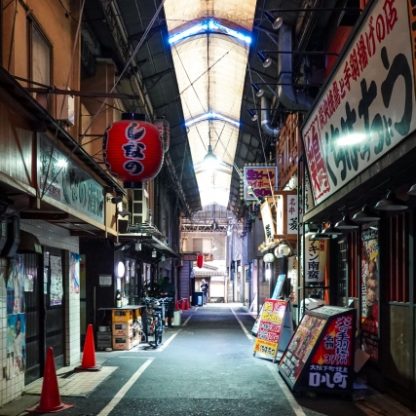
On the east side of Tennoji Station, an area known as Ura-Tennoji has narrow lanes with small restaurants. It can be interesting for an adults’ evening out, but for three-generation groups, choosing a clear, easy-to-find restaurant near the station earlier in the evening is often less complicated.
In our view, a family gets more from Osaka when the route home is predictable than when it chases one dramatic photo in the middle of a tourist area. Finishing the day without being completely worn out tends to matter more later.
Where to stay near Tennoji: 6 accommodation options
When staying for a Tennoji Zoo visit, the question is often less about how grand the accommodation is and more about whether you can leave easily in the morning and gather to discuss the next day when you return. You may be thinking, “Wouldn’t a hotel be easier?” For two to four people, a hotel near the station can work well. For several families or three generations, a whole-house stay is worth comparing.
As group size grows, being able to sit at the same table rather than split into separate rooms can change the rhythm of a trip more than expected.
Choose by group size, from station hotels to whole-house stays
These are six accommodation types with convenient access to Tennoji Zoo, rather than a ranking of individual properties. Prices can vary substantially by day of week, event dates, booking timing, and group size. Compare the total at the booking stage, including the number of rooms you actually need—not only the displayed rate for one room.
1. Business hotels near Tennoji Station — Within walking distance of Tennoji Station. Suitable for two adults or one parent-and-child group wanting to head straight to the zoo the next morning. If booking separate rooms, check the total cost and child bed-sharing conditions. 2. Hotels with family-style rooms in Abeno — Convenient for Tennoji Station and Tennoji-ekimae Station. A good fit for families adding shopping or Abeno Harukas. Prices in this area can move quickly on weekends and public holidays. 3. Hotels around Shin-Imamiya and Dobutsuen-mae Station — For travellers prioritising the roughly five-minute walk from Dobutsuen-mae Station. They can also suit adult groups wanting to explore Shinsekai at night, but check room size and the neighbourhood’s evening atmosphere before booking. 4. Hotels and apartment-style stays in Namba — Namba Station is about five minutes from Tennoji Station on the Midosuji Line. Suitable for families making Dotonbori and Kuromon Market the centre of the trip, with the zoo as one day out. Expect more crowds and more movement in the evening. 5. Small stays and private rentals in Teradacho — One Loop Line stop from Tennoji Station, taking around two minutes. This lets you stay a little outside the busiest tourist areas and travel into Tennoji in the morning. It can also suit groups wanting shared time rather than booking several separate rooms. 6. CONTEXTED Osaka — A whole-house rental in the Teradacho/Tsuruhashi area for up to 23 guests. It is one option for family trips, several families, or three-generation groups who want one shared base. Tennoji is one stop from Teradacho on the Loop Line and three stops from Tsuruhashi. Facilities, rates, and availability vary by date, so check the latest details on the booking page.
If you want to explore Tsuruhashi’s yakiniku restaurants and Korean food shops the day after the zoo, staying around Tsuruhashi is another sensible option. The smell of yakiniku often hits as soon as you exit the station gates; it is a neighbourhood whose energy can catch the adults’ attention before the children’s. With easy Loop Line access to Tennoji, staying outside the tourist centre has its own logic.
If you are deciding whether a whole-house stay works for your family or group, start by checking the total for your dates and guest count. Check availability & rates
Things to check on the day of your visit
Before leaving, check the closing day, last-entry time, weather, and event schedule. Monday arrangements and summer Night Zoo dates can differ from the usual routine. It only takes a few minutes before you leave your accommodation or board the train, and it can prevent an awkward change of plan.
Three checks to make before entry
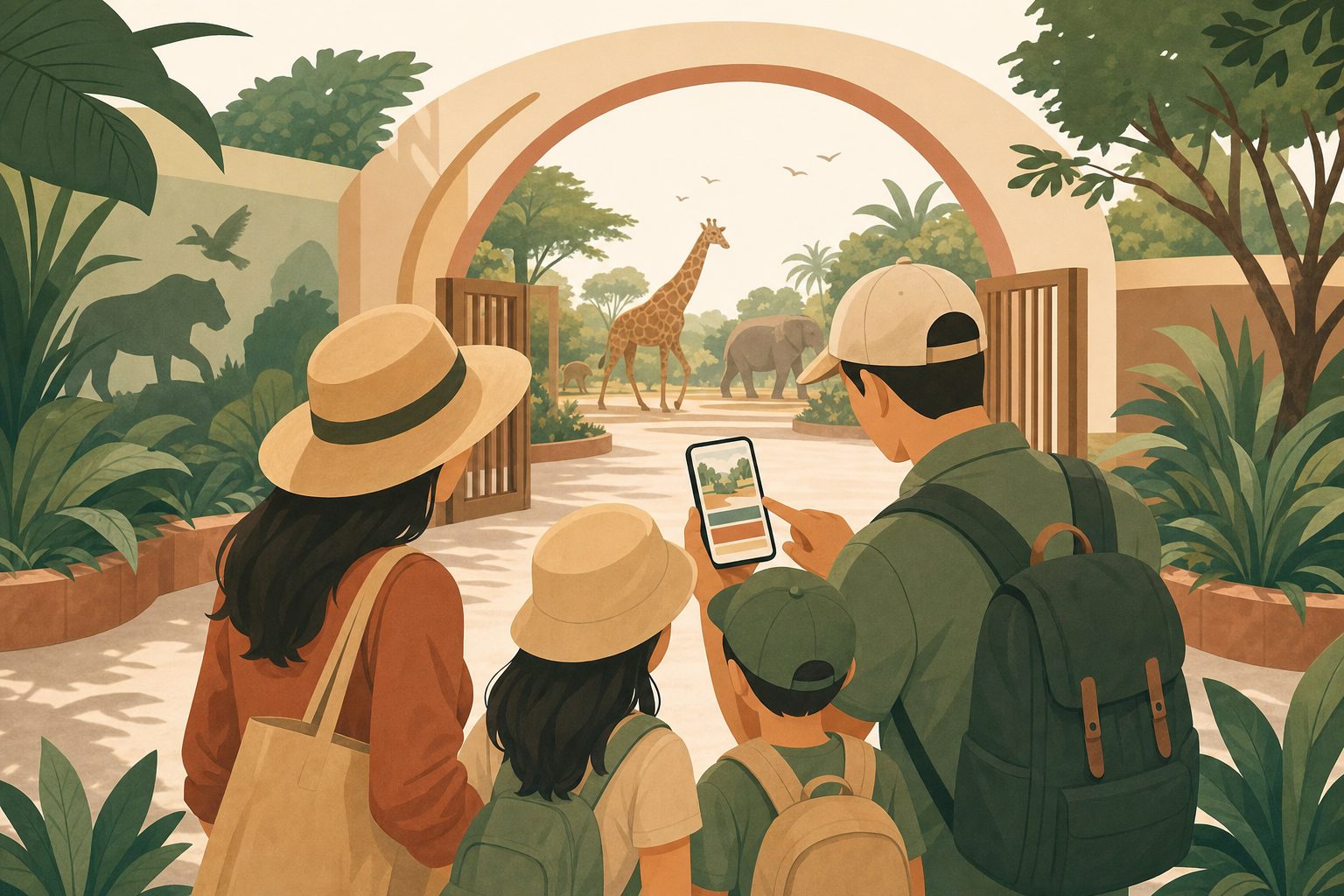
The official website posts opening information and event notices. The more your plan depends on a children’s programme, the more important it is to check the date, registration details, and eligibility in advance. Finding out on arrival that an activity is not running can be difficult, especially for the person who had been looking forward to it most.
A Monday visit
If Monday is a public holiday, the zoo closes on the following weekday. Check the calendar by specific date.
Afternoon entry
Last admission is 4:00pm and closing time is 5:00pm. Work backwards from the time you want for sightseeing and meals.
Lunch in Shinsekai
Weekends and public holidays can be busy. With children, allow for queues and keep more than one restaurant in mind.
Planning around Night Zoo
This is a summer-only event. Check the official announcement for dates, times, and ticket arrangements.
Put the journey back to your accommodation in the plan
After walking around the zoo, Shinsekai, and Abeno, both children and adults may feel the distance more than expected. It is fine to skip a forced dinner trip to Namba, eat around Tennoji Station, and return to your accommodation instead.
Osaka’s travel distances are short, which is exactly why it can be nice not to treat your accommodation as somewhere only to sleep. For groups, time spent spreading out photos and saying, “We saw that animal,” can be part of the trip too.
FAQ
Admission and opening hours
Q: How much is admission to Tennoji Zoo? A: Regular admission is ¥500 for adults (high school age and above), ¥200 for elementary and junior high school students, and free for preschool children. Annual passes are ¥2,000 for adults and ¥800 for elementary and junior high school students. Prices may change due to revisions or special programmes, so check the official website before you go.
Q: What are Tennoji Zoo’s opening hours? A: Normal hours are 9:30am to 5:00pm, with last admission at 4:00pm. The zoo is closed every Monday; if Monday is a public holiday, it closes on the following weekday instead. Check the official calendar for temporary changes.
Access and family travel
Q: Should I use Tennoji Station or Dobutsuen-mae Station? A: If you are focusing on Shinsekai, allow about five minutes on foot from Exit 1 of Dobutsuen-mae Station. If you prefer Abeno or are using JR, allow about 10 minutes from the central ticket gates at Tennoji Station. Choose based on where you want to go afterwards for the smoothest route.
Q: When is the least crowded time to visit Tennoji Zoo? A: Weekends, public holidays, and long school holiday periods are likely to be busier. Weekday mornings are generally easier to walk around. Entering near opening time makes it simpler to use the time before lunch for the zoo.
Q: Can I visit Tennoji Zoo and Shinsekai on the same day? A: Yes. Shinsekai and Tsutenkaku are about a five-minute walk from the zoo’s north entrance. A morning zoo visit followed by lunch in Shinsekai is an easy order, though families with toddlers will have more breathing room if they keep the zoo visit focused.
Q: Is Tennoji Zoo easy to reach from Teradacho or Tsuruhashi? A: From Teradacho, Tennoji is one stop on the JR Osaka Loop Line and takes around two minutes. From Tsuruhashi, it is three stops and about five minutes. Add roughly 10 minutes on foot from Tennoji Station to the zoo when deciding what time to leave in the morning.
Rather than rushing through Tennoji Zoo alone, the day usually comes together better if you add either Shinsekai or Abeno—not necessarily both. For larger groups, a base where you can look through photos and decide the next day’s plan after returning can make a real difference.
Choose the energy of the north side or the gentler pace of the south side first, and the rest of the day becomes much easier to shape. If a private whole-house stay around Teradacho or Tsuruhashi seems to fit your group, checking availability and the total rate by date and guest count is the simplest way to decide. Use the latest information on the booking page for accommodation details. Tennoji is close enough for an easy morning start, while the evening can still be spent settling in together.
RESERVATION
A whole-house stay in Osaka for your group
Walkable to Tsuruhashi, Tennoji, Shinsekai, Dotonbori and Kuromon Market. Sleeps up to 23 — perfect for families and groups to book the entire house. Check availability and rates on the booking site.
Please confirm current rates, availability and amenities on the booking site.
Sources & References
- Tennoji Zoo Official Website
- Osaka Convention & Tourism Bureau Official Website
- City of Osaka Official Website
Related articles